Product placement in video games – pilot by an inconsistent author
- Vladislav Kasyanenko
- Sep 30, 2020
- 3 min read
Video games have been around for quite a while. Actually, the first video game saw light in 1940 (Video game history timeline, 2016), even though it was completely different from anything we are used to seeing now – it was even hardly possible to call it a video game. The first videogame that was close to our common perception of it was a chess program invented by Alex Bernstein in 1957 (Video game history timeline, 2016). Then, in 1958 William Higinbotham created a tennis videogame (Video game history, 2017), that has a more official status of the first-ever made, as well as the game that anticipated such games as Pong.
The industry really takes off in the early 70s, Atari enters the market with its home consoles, Sega makes Sonic the hedgehog, first PlayStation comes out, Doom and Diablo change the video game industry landscape, etc. But we are not here to discuss video games’ history, are we? At least not in the usual way. If you just want to learn about the history of gaming – click here, at least that is where I learned about it (Not a native integration). No, in these series we are going to talk about advertising in video games or using more suitable terms – product placement. Welcome to my swamp, let’s begin.
For starters, it is important to understand what the term “product placement” actually means. According to The Cambridge Dictionary, product placement is “a way of advertising a product by supplying it for use in films or television programs” (Cambridge Dictionary, n.d.). I am pretty certain that you can remember at least a couple of examples of various brands being featured in movies, in case if you don’t, here is a trio that will surely refresh your memory.
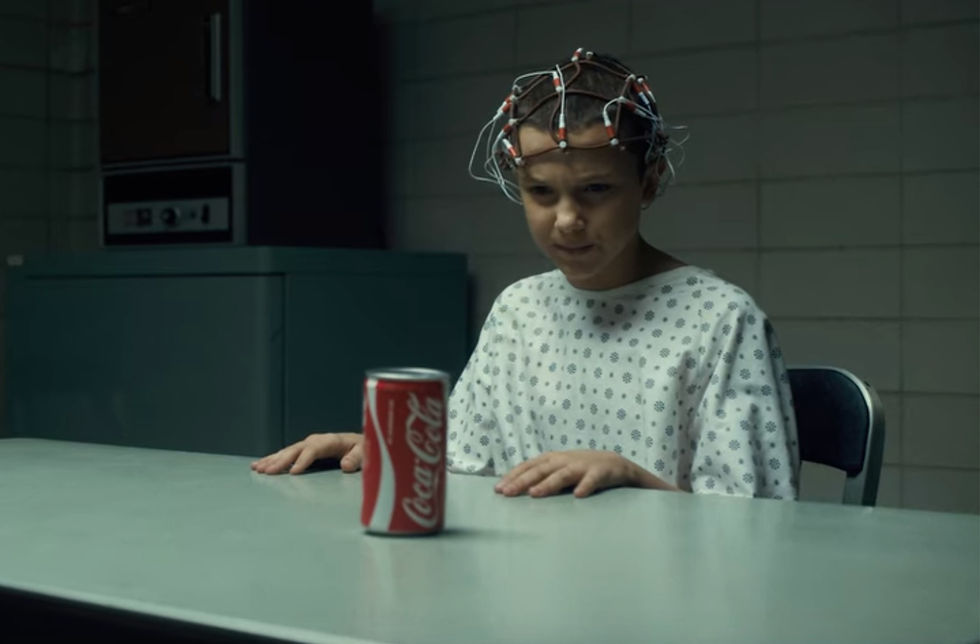

As you could have noticed, video games are not really mentioned in the definition of product placement and I doubt that by googling “product placement definition” you will find any that mentions video games. Why so?
Because of the history. See, product placement as us - consumers know it appeared years ago and takes its origins in literature (Hackley, 2020). For example, in the novel by Charles Dickens “David Copperfield” that was published in 1850 in the third chapter you can find an integration of a magical medicine “Dr. Locock’s Pulmonic Wafers” that promises the reader to cure his cough (if he has it) in minutes. Another example is Jane Austen’s novel “Mansfield Park” published in 1814. In chapter twenty-two, the author mentions an umbrella brand “W. & J. Sangster” and their umbrellas claims to be of superior quality because they are made of alpaca material. A lot of well-known writers such as Bram Stoker, William Thackeray and George Elliot integrated various brands in their works (Hackley, 2020). Back then these methods proved themselves to be very effective because people were not used to advertising in general and used to be very trusting.


Let’s come back to present times and mention that right now product placement is a very big business direction that keeps on growing – in 2019 it earned $11.44 billions in the US (Statista, 2019), the same report states that around 49% of Americans actually took action after being affected by product placement in media environment (Statista, 2019). Unfortunately, there is not a lot of opened statistical data about product placement in videogames regarding the last few years, due to the fact that only recently the industry started to get acknowledged by big brands (Sharbatian, 2020).
That again raises the question – why so? Easy – it is hard to measure if it is not a key gameplay element. Comparing to movie product placement, which is manipulated by moviemakers in such a way that viewers see the brand either way, in videogames it also depends on players – they can just miss it if it is not integrated into the plot or is not presented as a gameplay feature. That fact can scare advertisers away from video games, especially if they want to promote a brand with law awareness – players can assume that it is just a part of the videogame’s universe.
You have read a demo version of the article, follow us on social media get the full one. Just kidding, we are not a free-to-play. That was a short intro into the topic of advertising in video games. In the next chapter, we are going to talk about the types of product placement in video games, as well as about the effectiveness of each one of them.
Still follow us on social media, would be nice.


Thanks for the article - interesting read! I'm wondering, is there a big difference in product placement in movies and TV shows compared to video games? Video games are interactive, and it can be that players would be exposed to them much longer (i.e, in an open world like Grand Theft Auto (GTA) where the player would keep running into billboards). Would that mean that product placement in video games can be considered to be more effective than in series and movies?